Monday, 23 December 2013

Review: The Moonstone (BBC style)

The Moonstone
BBC Adaptation
1997 (it's time for a new one, surely?)

I stumbled on this adaptation when I was about half way through The Moonstone. I finally watched it about a week ago and, as much as it was satisfying to see the novel come alive on TV, I was left feeling a bit unimpressed. I think the characters were written really well and remained close to the book. Clack could have been a little more wheedling and Rosanna was played a tad wimpish (I thought she was anything but a wimp in the novel) but other than that I think they were all more or less spot on. Greg Wise as Franklin Blake had wonderfully flowing hair and was hilarious in the opium state. Keeley Hawes as Rachel Verinder was suitably stroppy and she said 'Clack' exactly as I imagined, but I do think her love for Franklin was hammed up a little (kissing his opium tainted glass etc.). The real challenge was Betteredge and I think they succeeded in staying true to Wilkie's original. There was not a single reference to Robinson Crusoe (they were sorely missed, I tell you), but his relationship with the other servants was brilliant to watch.

I think that having just read the novel makes the accuracy of the story a low priority and my enjoyment was certainly not reliant on it. It was a two hour adaptation of a 500 page novel - they had no chance in hell of getting it all in there. Good effort made all round, though. It feels very quick because everything that is slowly revealed in the book (via various tangeants in Betteredge's case), is revealed at top speed. Needs must I suppose. Still, if you're suffering from the post-Wilkie slump that I have been then I'd recommend watching this for a slightly different dose of The Moonstone.

Bottom line: worth a watch, just don't go mad for it.


Do any of you lovely #readWilkie participants want to watch this? I'd like to pass it on to you guys to watch...let me know!


SHARE:

Friday, 20 December 2013

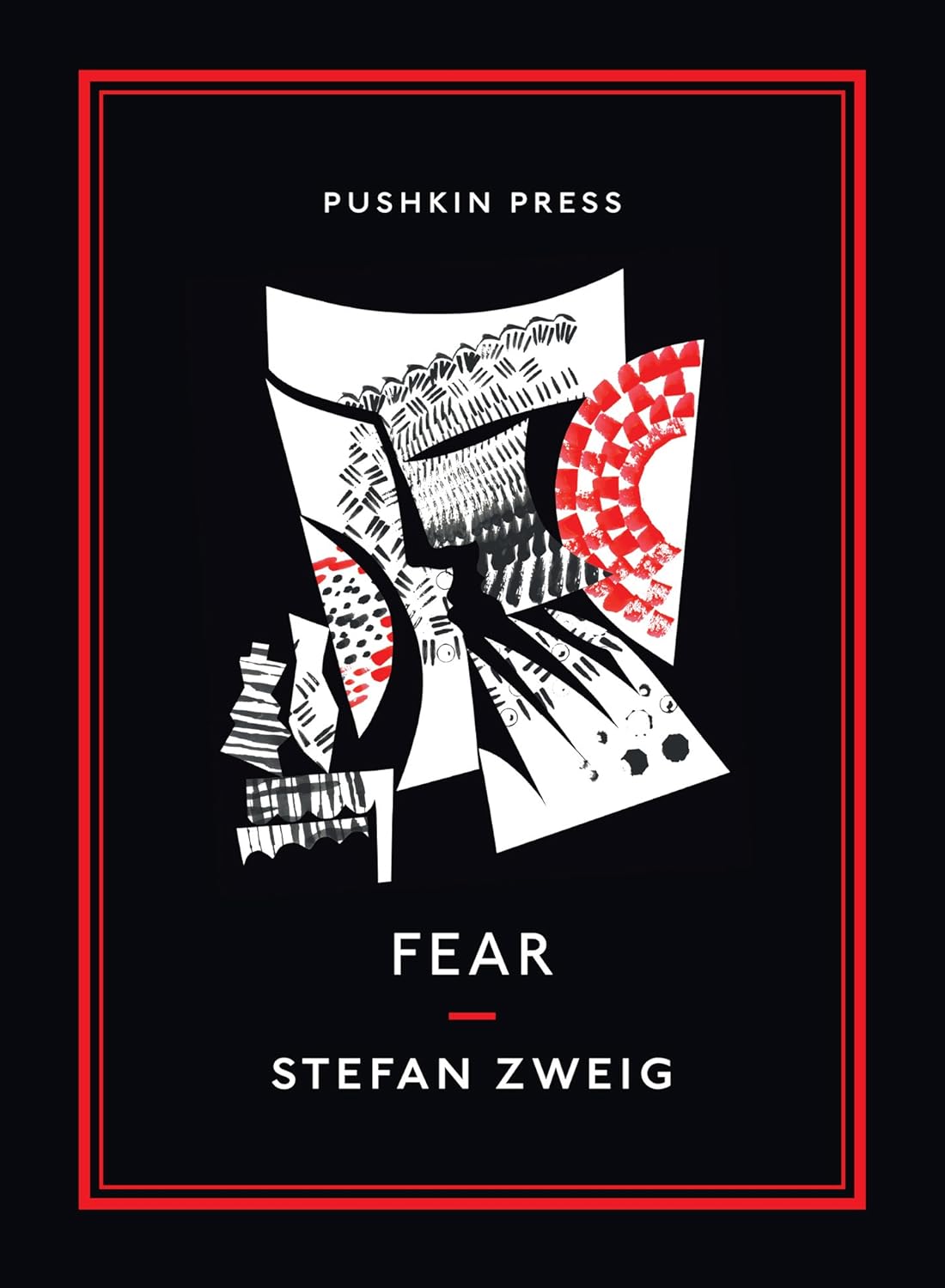
Review: Fear by Stefan Zweig


Fear 

Stefan Zweig
1920
Pushkin Press (2013)
106 pages

Translated by Anthea Bell


Translation Challenge #11


'The horror had now moved into her home and would not stir from its rooms.'

Stefan Zweig is a name I have been noticing more and more frequently in bookshops. I'm slightly embarrassed to admit that I had no idea who he was and knew nothing about him apart from the fact that seemed to be prolific. According to Wikipedia (font of knowledge) he was pretty famous. Having devoured Fear in no time at all, I can see why.


Fear was first brought to my attention by Lindsay in her review back in May. The subject really intrigued me and I'm glad it stayed in my mind long enough for me to pick up a copy (hello you beauty from Pushkin Press).


Irene Wagner is a bourgeois wife and mother, bored with her mundane existence.  She begins an affair with a young pianist but, upon leaving his apartment one day, she bumps into his former lover who begins to blackmail her. 


Considering the concept of blackmailing an adulterer/adulteress is rather familiar nowadays, Zweig has this incomparable skill for creating a claustrophobic atmosphere that makes the subject completely terrifying. Irene's fear of being found out is palpable to the point that it made me tense. As a reader I did not feel like I was outside the novel but rather within it and sharing in Irene's terror. Skills.


Fear is a study of relationships and the games people will play in relationships. The twist towards the end revealed how much of an emphasis is actually put on gender relationships (particularly gendered power relationships). It reminds me of two other books I have read this year (both also on the Translation Challenge coincidentally) - Anna Karenina and Madame Bovary - in its treatment of women doing 'wrong' in romantic/sexual relationships and the lengths they will go to to avoid the consequences. What I find most distressing is that death seems to be the only way out for such women. All three female protagonists consider suicide to be the better option than dealing with the shame and scandal that comes with being aware of their own sexual wants. Even when knowing that these women are all products of their society and culture, I find the idea of death as an escape from shame immensely depressing. 


Zweig was a contemporary of Sigmund Freud and I think that is noticeable in the novel. If you are a fan of psychological, Freudian literature, I would strongly recommend breezing through this very short novel. It is twisted, affecting and more than a little disturbing. I could say so much more about it but I won't, because I think you should all read it and see for yourself.


''Do you think it's...it's always just fear that...that keeps people from speaking out? Couldn't it be...well, couldn't it be shame?''


SHARE:

Monday, 16 December 2013

Mini reviews: dystopian worlds and a hundred year old man

The Testimony
James Smythe
2013

A couple of months ago I joined a book club in London, a book club that reads post-apocalyptic and dystopian fiction. Could a book club get any better? I think only a book club devoted to Wilkie would beat it. Anyway, The Testimony was the second book I read as part of the club although I did not actually go to the meet up *slaps wrist*. I hadn't quite finished the book on the day and it really is one that could be spoiled entirely by someone slipping the events of the ending into discussion. Which, in this case, was bound to happen. 

Even a couple of weeks on, I'm finding it hard to decide how I feel about this book. Perhaps that says it all. Perhaps the fact that I'm still thinking about it two weeks later completely illustrates the impact of this novel. I'm not going to do a synopsis because I think it would be hard to without spoilers but lets just say it is about an 'event' that involves the entire world and humanity's reaction to it. It is a book that definitely encourages DEEP THOUGHTS. Deep thoughts still give me the wibbly wobblys but I actually really enjoyed it here. I think the style and structure (it is written from the point of view of multiple narrators recounting their experiences), contributed to the endless deep thoughts skipping round my brain but also lessened the deep thought headache. Some of the narrators I really connected to and was interested to read what they had to say next. This novel wouldn't work written in any other way. It's power relies on the multiple narration and the inferences that can be made from the individual experiences. 

If you fancy a brilliant piece of dystopia with a side of deep thoughts, I'd highly recommend this. The ending disappointed me somewhat but the reading experience in general is worth having.

The Hundred Year Old Man Who Climbed out of the Window and Disappeared
Jonas Jonasson
2012

If I did star ratings this book would get top marks. Both my sister and my flat mate had read this book before it made it to my bedside and they both completely adored it so my expectations were pretty high going into it. I was not disappointed. This is a truly entertaining novel, full of giggles, clever references and absurdly brilliant situations. It's also a haven for history geeks. 

The novel tells the story of Allan Karlsson, a hundred year old man (funnily enough), who climbs out of the window in his care home and doesn't look back. Allan has led a remarkable life and has a phenomenal talent for getting himself out of all manner of mischief. He also has a skill for finding mischief. There are two stories making up this novel. The first is Allan's present and the other is Allan's past and they eventually converge when Allan is getting himself out of one last pickle. 

I can't recommend this book enough. It is funny, uplifting and populated with some amazingly imagined characters (I'm a fan of The Beauty, myself). Read it. That's an order (although I think most people have, I'm a bit behind as always). 


SHARE:

Thursday, 12 December 2013

Winter Reads

As I am clearly a weather woman, I am going to announce that we are definitely in winter now. It's official. I'm sat in my house with a hat on and am seriously considering the practical implications of fingerless gloves (so far they're looking like a necessity). If there is one thing about winter that I love it is the reading mood it puts me in to. There is nothing better than snuggling up under a blanket (or three), with a hot water bottle, a cup of tea and a good book. The Moonstone readalong eased me into the season of reading and now the Dickens readalong hosted by the lovely Bex is just making me hella happy. 

I'm not a huge reading planner and I think reading is actually the only area in my life where I am able to be spontaneous but I really do have an idea of what I want to read over the next couple of months. The following are all what I would consider to be 'wintry' books - books that I just want to curl up with and read for hours. Don't let me down, guys, don't let me down.


1. A Tale of Two Cities by Charles Dickens
Dickens and winter are pretty much made for each other. It's working for me so far - an excellent pre-Christmas read.

2. The Lie by Helen Dunmore
A new release for 2014 (hello Centenary bandwagon, I love you). Dunmore is one of those consistently good writers so I'm really looking forward to seeing how she approaches the war. Please no cliches, Helen.

3. The Knife of Never Letting Go by Patrick Ness
Who doesn't love a sobfest in winter? Ness has had me in pieces with every book I've read so far and I have no doubt that this will go the same way. He is so good.

4. The Bookman's Tale by Charlie Lovett
It's bookish and mysterious = win.

5. The Last Runaway by Tracey Chevalier
Like Helen Dunmore, Tracey Chevalier is one of those writers I can always rely on to produce a darn good story. I went to a reading of this in the summer and have meant to read it ever since.

6. Magda by Meike Ziervogel
I saw Meike talk about Magda and the women of the Third Reich in the summer which just encouraged my interest in the subject. It's only a short novel but I am pretty certain it will be a thought-provoking one.

7. The Book of Lost Things by John Connolly
Again, bookish and mysterious = win.

8. Z by Therese Anne Fowler
This feels like it should be a summer read given the subject (Zelda Fitzgerald) but I think it will be one I don't want to put down once I get started. I think I may read this in January for Leah's Jazz Age in January event.

9. Stoner by John Williams
Waterstones book of the year 2013 and quite the publishing sensation  - can't go wrong. Plus, there are books on the cover (it's the little things).

10. The Day of the Triffids by John Wyndham
Dystopian sci-fi goes so well with dark, bleak days. This is on my Classics Club list and I've been excited to get to it since finding it at the South Bank Book Market.


Have you read any of these? Have I picked some good winter reads? What is on your TBR for the next few months?


SHARE:

Wednesday, 11 December 2013

Review and Interview: Getting Rooted in New Zealand by Jamie Baywood

Getting Rooted in New Zealand
Jamie Baywood
2013

I seem to be on a bit of an expat memoir mission currently. This is the second book in a month or so that follows a single female moving to a completely new country for a fresh start and new experiences (see also At Least You're in Tuscany). I'm not worried though, I've loved both of them.

Getting Rooted is a hilarious, often filthy (right up my street), honest and really quite uplifting (when you think about it) memoir about Baywood's experiences in New Zealand. The style took some getting used to as it is almost a collection of shorter impressions, sketches and stories rather than a structured, linear memoir. I think, considering the content, this is the best structure for it. Baywood's voice is so distinctive and friendly to the point that it feels like you are sat in a coffee shop having a catch up with her rather than reading her words on paper. Quite a skill that. 

I asked Jamie a few questions about the book and her experiences so read on if you fancy...

1. Much of the humour in Getting Rooted comes from your honesty - were there any experiences you had to psych yourself up to include?

Publishing my story was easily the most terrifying thing I’ve ever done. I barely slept the first half of the year worrying what people would think of my book. I still haven’t told my family or my husband’s family about the book.  My life is literally an open book, but Jamie Baywood is a pen name. I haven’t told my family or husband’s family that I’ve written or published a book. They think I’m just living in the UK working on a MA in Design studying book covers.

At the beginning of the book, I wrote a rather embarrassing and cringe worthy long list of ex-boyfriends and suitors. It explains why the fact that New Zealand’s population of 100,000 fewer men than women made New Zealand an ideal destination for me.  I think readers need to remember this is the dairy of a young, hormonal and confused twenty-something, this is not a travel guide to New Zealand. 

I know it sounds like a crazy reason, but I needed a serious change in my life and felt I needed to leave the country to do so. I started dating my first boyfriend when we were fourteen and the relationship ended when I was twenty-three.  I had never dumped someone and didn’t have the life skills to do so. Between ages twenty-three and twenty-six, I would only date guys I knew I could dump easily. Not surprisingly, only dating guys with clear and abundant flaws that were easy to dump, created a lot of chaos and drama in my life.

When I was twenty-four, I had my second boyfriend who I call Hank, in real life his named rhymed with Hank. Hank had a drug dealer that sincerely went by the name Stank. I took Hank to rehab, after that I had a string of crazy suitors and ex’s.  If you had Hank and Stank in your life, what other choice do you have, but to leave the country and become an author?

2. You faced some really challenging and absurd situations. Did writing them down have a therapeutic effect? 

While living in New Zealand, I had funny experiences that I had trouble believing were true. I wrote the stories down to stay sane. It was absolutely therapeutic.  I wrote situations down that were happening around me and shared them with friends. Most of the book was written as the events happened; it just took me a few years to work up the nerve to publish. Publishing my book Getting Rooted in New Zealand was my way of transforming poison into medicine. I hope that it can help people that have had bad dating experiences or bad work experiences – make them laugh and not give up hope.

3. Your book is non-fiction but readers coming to it blind and without and background knowledge of your journey could easily mistake it as fiction. Do you mind that? And do you think that is reflective of your weird and wonderful experiences?

That’s ok with me. My truth tends to be stranger than fiction, but it is really too weird to be made up.  I had good, bad and weird experiences in New Zealand and California. Although I hope that I have learnt from my mistakes, I wouldn’t change anything. My experiences have turned me into a writer and I am extremely grateful for that. That being said, I would like to go back to New Zealand and give it another try as a writer.

4. Did performing a monologue for Thomas Sainsbury encourage you to keep writing about your life?

Yes, absolutely. I had the opportunity to write and perform for Thomas Sainsbury the most prolific playwright in New Zealand. I performed a monologue about my jobs in the Basement Theatre in Auckland.  The funny thing about that experience was Tom kept me separated from the other performers until it was time to perform. I was under the impression that all the performers were foreigners giving their experiences in New Zealand.  All of the other performers were professional actors telling stories that weren’t their own. At first I was mortified, but the audience seemed to enjoy my “performance,” laughing their way through my monologue. After the shows we would go out and mingle with the audience. People would ask me how long I had been acting. I would tell them, “I wasn’t acting; I have to go to work tomorrow and sit next to the girl wearing her dead dog’s collar around her neck.”

It would be great to return to New Zealand to make Getting Rooted in New Zealand into a TV show with Thomas Sainsbury. 

5. Did you have any intentions of becoming a writer before moving to New Zealand? 

I didn’t start keeping a diary or writing until I moved to New Zealand. I wrote to keep in touch with friends and family.  I saved the emails that eventually became my book.
My education is in fine arts, I didn’t write until I moved to New Zealand. I had a lot of art shows in California and New Zealand and even managed an art collective in Auckland. I was bored with the fine art scene. Everything has already been done before in painting, but I am the only person that can tell my own story. Writing feels like a more honest form of art than any other method I’ve tried.

6. After New Zealand you moved to the UK - will there be sequels?

I’d like to write a prequel and sequel to Getting Rooted in New Zealand. I plan to divide my books by the countries I’ve lived in. My next book will be about attempting to settle in Scotland. I plan to publish it late 2014.

7. And finally, I ask everyone this, what has your favourite read been this year?

May I Ask You Something? by Cyan Corwine.

Getting Rooted in New Zealand is available in paperback and ebook on Amazon:  http://www.amazon.com/dp/1482601907
Jamie Baywood can be followed on the following sites:


Facebook.com/jamiebaywood
Twitter.com/jamiebaywood
Pinterest.com/jamiebaywood

Thank you to Jamie Baywood for providing me with a copy to review and for answering my questions so brilliantly. Good luck for the next project!

SHARE:

Monday, 2 December 2013

Review: The Moonstone by Wilkie Collins #readWilkie

The Moonstone
Wilkie Collins
1868

Wilkie, Wilkie, Wilkie...I am speechless (it happens). Where do I even start singing the praises of this jaw-droppingly excellent piece of detective fiction? I guess the first thing to say is 'Wilkie, you've only gone and hit the spot once again'. 


I think we've all talked about the basic premise enough now for it to be quite clear but, in a nutshell, The Moonstone is about a jolly big diamond taken (nicked) from India by a slightly dodgy character who then bequeaths said ginormous diamond to his niece (potentially as punishment). Said stonking diamond is then stolen and the novel becomes a whodunit of the best kind with some exceptional characters, numerous red herrings and a denouement that utterly shocked me. THE SKILL.


The Moonstone was serialised in All the Year Round over eight months (Victorians must have been in a constant tizz at the suspense). During this time Wilkie's mum was really poorly, he himself was struck prostrate and had to dictate a few pages, and he spent most of the time in an opium daze (parallels much?).


I flicked through my notebook to write this review and I have discovered that the majority of things I wrote down are related to women. Wilkie's treatment of women, Betteredge's delightful chauvinisms, and the odd bit of twisted feminism. What can I say, I love the ladies. 


'[Mrs Betteredge] was more like a fly than a woman: she couldn't settle on anything.' 


'But it is a maxim of mine that men (being superior creatures) are bound to improve women - if they can.'


It's fair to say that Betteredge completely makes the novel. He is hilarious (tube chuckles happened). I love his style of narration and the tangents he takes. I love it when he starts to feel the 'detective fever' and gets all excitable. I definitely love it when he gets all cheeky at the end during the experiment and gives his 'imperfectly pointed pencil a preliminary lick with his tongue' before continuing to thoroughly disapprove of Ezra. Poor Ezra, he had it rough. I also loved his general distaste of people who have failed to live by the good word - the good word of Robinson Crusoe, that is.


'The man who doesn't believe in Robinson Crusoe, after that, is a man with a screw loose in his understanding, or a man lost in the midst of his own self conceit.'


Harsh words, Gabriel. Harsh words indeed.


I really enjoyed Ezra Jennings's narrative (coming in at a close second to Betteredge). He is a stronger man than most for just taking all the hatred and distrust aimed at him on the chin. Just because he has dodgy hair (and a dodgy appearance in general) and did something way back when, it doesn't make him a bad person. But, I find it kinda weird that he is pretty much the town doctor whilst Candy is, um, indisposed. He does seem to have a bit of the genius about him though. I actually browsed back through the novel upon finishing it and I came across a mention of Ezra early on in Betteredge's narration that eludes to the general dislike of the poor fellow. That made me wonder what the experience of re-reading would be like. I've re-read The Woman in White several times and every time I discovered something new so I'm guessing it would be much the same here. I wonder if the perpetrator will become obvious earlier if I know what to look for.


Speaking of perpetrators - did anyone guess that ending? I so did not. I found the opium element brilliantly outlandish and it explained away all of Rachel's general spoilt brat-ness. But the person who actually did the deed? I totally didn't think he had the stones for it. Although, again when I was flicking back through my notebook, I wrote down this quote: '[he was] ogling Miss Rachel'. 'He' is the perp. I clearly knew subconsciously from the start that he was a little less than a gentleman. Ogling is so ungentlemanly.


To sum up my meandering and rambling thoughts: basically, it's love. I knew it would be but to have it so brilliantly confirmed has been wonderful. It is not quite as sensational as The Woman in White but completely on par with it. Wilkie Collins has officially made his way into the top spot as my favourite author. I have nothing left to say now except, read it. Just go ahead and read it, enjoy it, laugh at it and love it (with any luck).


Fun fact: Sergeant Cuff, aside from being an eccentric-rose-loving-babe, was also one of the first fictional characters to use a magnifying glass. Cool, huh?


Previous #readWilkie posts (including those with participant links): 

#readWilkie: The Start
5 Reasons to Love Wilkie Collins
#readWilkie: The Half-Way Point
#readWilkie

A big virtual hug and pat on the back to all you lovelies who read Wilkie with me and made November a top notch month.


SHARE:

Sunday, 1 December 2013

#readWilkie


It's the beginning of December and #readWilkie is officially over (I'm holding back sobs as I type). It was a wonderful month full of Wilkie goodness. I loved chatting to you all - let's do that again sometime - and I have loved reading your thoughts on The Moonstone as we've read it. Basically, November turned out to be a pretty spiffing month. How has it been for you? Wilkie-tastic? Or a Wilkie flop?

My thoughts on The Moonstone will go up tomorrow (or later today, depending on wifi) and later in the week I will post a review of Peter Ackroyd's brilliant biography that I cannot recommend enough. 

In the meantime, let me know how your month went and whether you intend on meeting Wilkie again in the future. Below is a linky thing to link your reviews/wrap-ups. 

Thanks for joining in, you've all been wonderful!


SHARE:
© Lit Nerd. All rights reserved.
Blogger Templates by pipdig